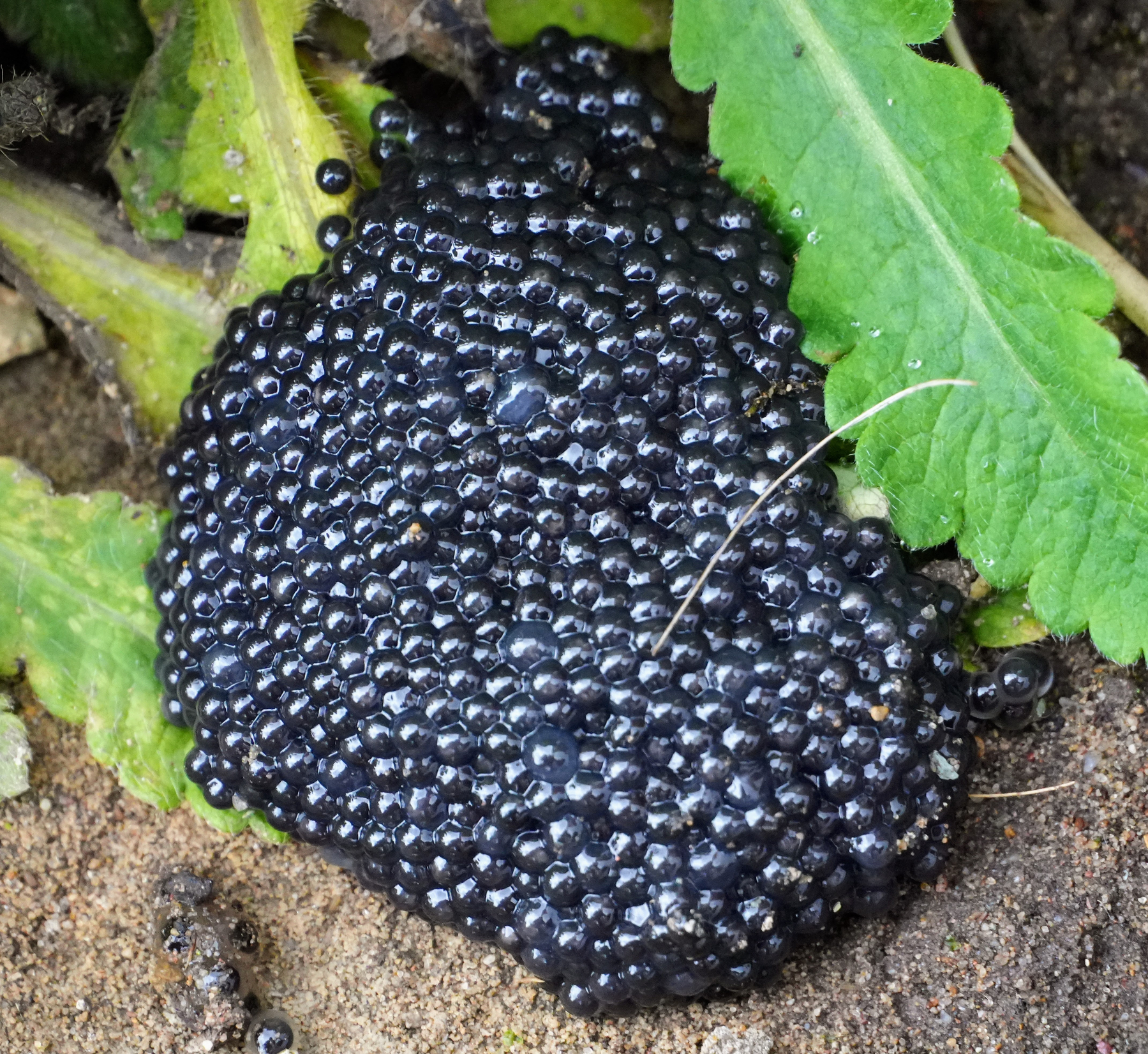
This morning, I thought I’d found a small, but perfectly formed, lump of black pearl slime mould just outside our back door. Each “sporangium” was about 2mm across and looked perfectly black. The whole mass was about 6 cm across. Subsequently, I found two other lumps in a direct line to the pond…
Somewhat suspicious, I scraped up a very sticky lump and dropped it into a bucket of water. Within half an hour, it was expanding and showing transparent albumen and central black nuclei. Frog’s eggs!
I suspect that a couple of our garden frogs joined in amplexus, and then couldn’t get back over the low wall of the pond. I moved the remaining eggs into our tadpole enclosure, though I’m not sure if they will be viable. We don’t know how long the spawn had been sitting on the damp earth. Possibly not long, as the local magpies hadn’t found them.
This is the earliest I’ve found frogspawn in the garden. Normally, we don’t expect to see it for another two weeks or so.
If you find frogspawn in a problematic place, like a dried-up puddle, it is not advisable to move it to a nearby pond, as this could spread disease. However, it is relatively easy to raise tadpoles in a bucket or an old washing-up bowl. See the Sussex Wildlife Trust for details.